


Red Light Therapy Benefits: A Scientific Overview
Your body was built by sunlight and longs for you to get more of it. Humans are not domesticated indoor creatures.
You Already Know The Impact Light Makes
You've felt it. That first warm morning after a long winter where you step outside and something inside you just… turns on. Your mood lifts. Your skin looks better. You sleep deeper that night.
That's not a metaphor. It's biology.
Every culture in history has had a word for it. The glow of a person who's thriving.
Qi. Prana. Aura. Vitality. We've always sensed that light and life are connected. And it turns out, we were right. We just didn't have the vocabulary to describe the depth of this relationship until fairly recently.
Today, thousands of peer-reviewed studies have mapped what happens when light meets living tissue. The field is called photobiomodulation. It’s a complicated word for a simple idea: light changes how your cells work.
Red light therapy uses targeted wavelengths of red and near-infrared light to support your body at the cellular level. Wavelengths your cells were designed to absorb.
Here's a quick breakdown, and how it applies to real life.
How Does Red Light Therapy Work in 60 Seconds
Say it with me, “mitochondria is the ____________!”
While almost everyone knows this “Powerhouse Of The Cell” line, most people don’t realize these little energy factories run on LIGHT.
Muscle recovery, collagen production, immune function, brain activity. All these processes require the Mitochondria to function properly.
Red and near-infrared light are absorbed by a specific enzyme in your mitochondria called cytochrome c oxidase. When this enzyme absorbs the right wavelengths, it works more efficiently. More ATP (that cellular energy) gets made.
Cells have more energy to do their jobs and function better because of it.
But there's a beautiful cascade that follows. The light also:
- Releases nitric oxide, which improves blood flow to the area
- Triggers a local antioxidant response that activates your body's own protective mechanisms
- Supports a healthy inflammation response by influencing how immune cells behave
Light therapy is simply giving your cells the light energy they need to function the way they're supposed to.
Function the way they did when we spent our days under open sky instead of fluorescent panels.
The Wavelengths That Matter
Not all light does this. Your body has an "optical window" or a specific range where light penetrates tissue instead of bouncing off or being absorbed by water.
Red light supports skin health, collagen structure, and surface-level healing.
Near-infrared light shines deeply through skin, into muscle, connective tissue, and even bone. This is the range that supports joint comfort, muscle recovery, and deeper tissue wellness.
The combination of both ranges (as always delivered in nature) consistently outperforms either one alone in clinical studies.
There's also emerging research on non-visual light receptors called opsins you may have heard us talk about.
These light sensors in your skin, brain, and other organs respond to specific wavelengths of light independently of your eyes. Our skin literally has its own way of "seeing" light.
These light sensors all over our bodies reinforce what we intuitively know: we are light-responsive organisms, head to toe.
Red Light Therapy for Skin: The Strongest Evidence
If there's one area where the science is especially clear, it's skin. Red light therapy for skin is quite well studied.
One often referenced study followed 136 volunteers through 30 sessions of red light exposure. Both treatment groups showed measurably smoother skin texture, and improved complexion.
They also had increased collagen density beneath the skin (confirmed by ultrasound imaging).
That's real structural change happening, directly from LIGHT.
Another gold-standard study (double-blind, split-face design with 76 subjects) found up to a 36% reduction in wrinkles and a 19% increase in skin elasticity after treatment with 633nm and 830nm light.
The cells responsible for building skin's structural proteins were upregulated, directly from LIGHT.
Red light does two things simultaneously: it promotes collagen production while also reducing the enzyme that breaks collagen down.
The light isn’t just building more, but protecting what you have.
For skin benefits, expect results within 4–8 weeks. Patience and consistency matter.
Learn more about how your skin responds to light.
Red Light Therapy for Hair Growth: Quietly Impressive Data
This one surprises a lot of people, but the evidence is solid.
Multiple double-blind, placebo-controlled trials show that consistent red light exposure supports hair density.
One study found a 35% increase in hair count over 16 weeks using 655nm light every other day. The largest trial enrolled 269 participants across multiple centers and found statistically significant improvements in hair density in both men and women.
The mechanism appears to promote the growth phase of the hair cycle and increase blood flow to the scalp.
An interesting finding: treating every other day worked better than daily treatment in several studies. More isn't always better.
Most successful hair studies were run over 16 to 26 weeks. This is a benefit that compounds and again, rewards consistency.
Red Light Therapy for Pain, Joints, and Inflammation
Your body's inflammatory response is supposed to be temporary, not long lingering inflammation and pain.
A burst of activity to handle a problem, then a return to baseline. But modern life (stress, poor sleep, sedentary habits, processed food) can keep that dial turned up.
Red and near-infrared light appear to help recalibrate this system.
Light therapy has been shown to reduce pro-inflammatory signaling molecules while supporting anti-inflammatory markers.
Immune cells also see a benefit, encouraging a shift from a "fight" mode to a "resolve and repair" mode.
In practical terms, the most robust evidence is for knee and jaw comfort:
A meta-analysis of 22 placebo-controlled trials (over 1,000 participants) found that PBM at appropriate doses significantly reduced knee discomfort and improved function.
These studies show a clear dose-response relationship. Enough exposure showed benefits, while underdosed studies didn't. This explains why some people try red light therapy and don't see results: the dose matters enormously.
A systematic review found that red light reduced neck discomfort for up to 22 weeks after a treatment course.
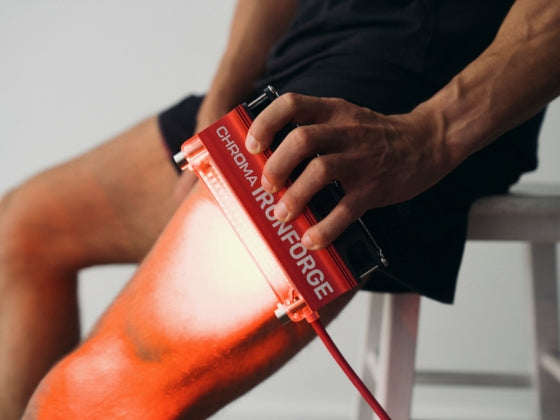
For joint support, near-infrared wavelengths are preferred because of their deeper tissue penetration. Devices with higher irradiance like our Ironforge device deliver energy more efficiently to these deeper structures.
Exercise Recovery: Pre-Loading Works
Here's one that athletes and generally active people find quite interesting.
Research shows that PBM applied before exercise can support performance AND recovery.
A review of 46 clinical trials (over 1,000 participants) found that both pre-exercise and post-exercise PBM supported recovery markers, but pre-exercise application showed stronger and more consistent results.
Studies on professional athletes demonstrated clear dose-dependent effects on creatine kinase (a marker of muscle stress). Adequate doses prevented significant elevation after intense matches, while insufficient doses didn't.
A meta-analysis of studies in healthy people found that red light therapy improved time-to-exhaustion and reduced blood lactate accumulation.
Just a quick Ironforge session before your workout may help you recover faster and feel less sore the next day. This lines up with what we hear from our community.
Sleep: It's About What Red Light Doesn't Do
Red light's connection to sleep is elegantly simple, and it works differently from the other benefits on this list. We go deeper on this in our guide to red light therapy and sleep.
Your brain decides when to produce melatonin (your sleep hormone) based on what kind of light your eyes (and skin) are receiving. The photoreceptor responsible, melanopsin is maximally sensitive to sky blue light around 480nm. When it detects this stimulating light, it signals your brain that it's daytime. Melatonin stays suppressed. You stay alert.
Red light falls outside melanopsin's sensitivity range. It simply doesn't trigger the "it's daytime" signal.
This is why red light is uniquely suited for evening illumination.
A 2025 comparative study found that after two hours of exposure, blue light kept melatonin suppressed while red light allowed melatonin to recover to more than three times higher.
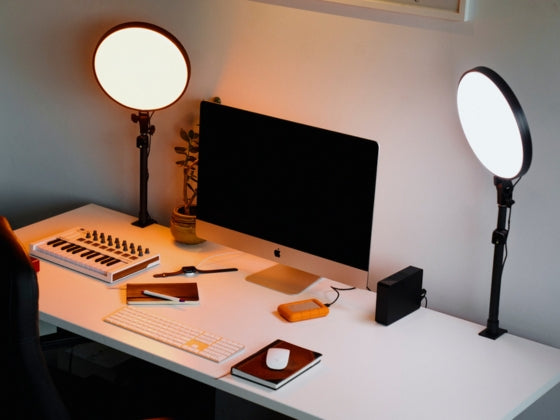
Outside of the daytime benefits, our Sky Portal & Red Portal lights provide usable light for your evening environment that works with your circadian biology. It's not adding anything exotic. It's just replacing the bright overstimulating light that's been disrupting your sleep.
Brain Health: Early, But Fascinating
We want to be upfront: this is the most preliminary area of PBM research. The findings are genuinely exciting, but the studies are small and the field is still new.
Red & near-infrared light does reach the brain.
The structure of the brain even appears to channel light to reach deeper than you might expect.
Near infrared light has been studied for its potential to support sustained attention and working memory in healthy adults.
Another study shows significant improvements in executive function and verbal memory with gains maintained for two months!
Our body is profoundly responsive to light, in ways we're still just beginning to map.
The Most Important Thing Most People Get Wrong
When people first encounter red light therapy specs, the numbers can feel intimidating. Irradiance measured in milliwatts per square centimeter. Energy density in joules. Treatment times in minutes.
Here's what actually matters: irradiance is just a measure of how efficiently light is being delivered.
Higher irradiance doesn't mean "more dangerous." It means your session can be shorter while delivering the same total energy to your tissues.
Think of it like a garden hose. A higher-flow nozzle fills the bucket faster. It doesn't flood your garden, you just turn it off sooner.
This is where a lot of devices fall short. Low-irradiance panels require you to stand in front of them for 20, 30, even 40 minutes to deliver a meaningful dose. That's not safer, it's just slower. And most people won't stick with a routine that eats that much time in the day.
A well-engineered device with higher irradiance, like our Ironforge, lets you get an effective session done in a fraction of the time. Same energy delivered to your cells. Less time standing around.
The real mistake isn't using "too much" light. It's not using enough, consistently enough. The clinical trials that show real results share one thing in common: participants followed a regular protocol over weeks and months. Consistency is the variable that separates people who see results from people who don't.
Red light therapy isn't magic.
Our cells are light-responsive. Specific wavelengths of red and near-infrared light support mitochondrial energy production, collagen synthesis, healthy inflammation response, and circadian alignment.
The evidence is strongest for skin health and hair density, solid for joint comfort and exercise recovery, and promising for sleep and cognitive function.
Humans evolved under a full spectrum of natural light. We spent millions of years calibrated to it.
The indoor world we've built in the last century stripped most of that away leaving us under artificial spectra that does not serve our biology.
Red light therapy isn't about adding something new to your life. It's about giving your body back something it lost.
This article is for educational purposes and reflects current peer-reviewed research. It is not medical advice. Chroma devices are general wellness products designed to support your body's natural processes. If you have a medical condition, consult your healthcare provider.
Frequently Asked Questions
Is red light therapy safe? Yes. A 2025 expert consensus panel of 21 international dermatology researchers confirmed PBM as safe and effective for skin and dermatological wellness applications, noting that red and near-infrared light do not cause DNA damage or carry the risks associated with UV exposure. Side effects in clinical trials are rare and typically limited to mild, temporary warmth.
How long does it take to see results? It depends on what you're using it for. Skin improvements are often noticeable within 4–8 weeks of consistent use. Hair density changes typically require 16+ weeks. Joint comfort and exercise recovery benefits can appear within days to weeks. Sleep benefits from evening red light use are often noticed within the first week.
Can I use red light therapy every day? For most applications, yes, but more isn't always better. Many successful clinical studies used every-other-day protocols, and some showed better results with less frequent use. Listen to your body and adjust accordingly.
Does red light therapy work through clothing? Thin, light-colored fabrics allow some transmission, but direct skin exposure ensures the most consistent delivery. For deeper targets (joints, muscles), NIR wavelengths penetrate further but still work best with bare skin contact.
What's the difference between red light therapy and infrared saunas? They're quite different. Red light therapy uses specific therapeutic bands of light at intensities designed to trigger photobiomodulation. Infrared saunas use far-infrared wavelengths, primarily to generate heat. The mechanisms, wavelengths, and biological effects are distinct. We’ll go into more detail on this later.