


That confusion makes sense.
EMFs are invisible.
They are everywhere.
And they interact with the body in subtle ways that are hard to feel in the short term.
That combination creates fear, denial, and a lot of bad information.
So let’s slow this down.
This article will explain:
- what EMFs actually are
- which types matter most
- what the science really shows
- why your phone is the biggest everyday issue
- and how Chroma approaches EMFs honestly and practically
No panic.
No gaslighting.
Just informed decisions.
INDEX:
- What Are EMFs, Really?
- Non-Ionizing Does Not Mean Harmless
- Why Your Phone Is the Biggest EMF Problem
- Natural EMFs vs Non-Native EMFs
- EMFs and Red Light Therapy
- Are There Any Benefits to EMFs?
- Where Chroma Stands
- So Are EMFs Dangerous?
- Conclusion
What Are EMFs, Really?
What does EMF even mean?
EMF stands for electromagnetic field.
An electromagnetic field is created anytime electricity moves or a wireless signal is transmitted.
That includes:
- power lines
- home wiring
- phones
- WiFi routers
- Bluetooth devices
- and light itself
EMFs exist across a wide spectrum. Some are natural. Some are artificial. Some are high energy. Some are low.
The biggest mistake is treating all EMFs as the same thing.
They are not.
Ionizing vs non-ionizing EMFs
There is one basic physics distinction that matters more than any headline.
Ionizing radiation
- X-rays
- Gamma rays
These carry enough energy per photon to break chemical bonds and directly damage DNA.
Non-ionizing radiation
- Radiofrequency (RF)
- Microwaves
- WiFi
- Bluetooth
- Visible light
- Infrared
- Red and near-infrared light
These do not directly break DNA.
This is where many conversations stop.
But stopping here misses the real issue.
Non-Ionizing Does Not Mean Harmless
Biological effects go beyond DNA damage
Non-ionizing EMFs can still affect biology without breaking DNA.
There are thousands of studies showing biological responses to EMF exposure through mechanisms such as:
- oxidative stress
- mitochondrial dysfunction
- calcium channel dysregulation
- altered neurotransmitter signaling
- hormone disruption
These are functional effects, not burns.
They are similar to what happens with:
- chronic stress
- poor sleep
- circadian disruption
Small inputs, repeated over time, can create large downstream effects.
The National Toxicology Program findings
This isn’t fringe science.
Their findings showed clear evidence of:
- increased cancer risk
- heart schwannomas
- brain tumors in rats
Animal data does not mean guaranteed human disease.
But it absolutely means there is enough evidence to justify concern and exposure reduction, especially for chronic, close-range exposure.

Why Your Phone Is the Biggest EMF Problem
Proximity matters more than power
Your phone is not dangerous because it is powerful.
It is dangerous because it is:
- carried in pockets
- held in hands
- pressed against the head
- used for hours every day
Distance matters.
EMFs follow the inverse square law.
That means:
- double the distance = four times less exposure
- ten times the distance = one hundred times less exposure
A phone in your pocket is a completely different exposure than a router across the room.
Bluetooth headphones and constant exposure
Bluetooth devices emit less power than phones.
But they are:
- worn directly in or near the skull
- used continuously
- often worn for hours at a time
Again, dose matters.
Low intensity does not mean low impact when exposure is constant and close to sensitive tissue.

Natural EMFs vs Non-Native EMFs
EMFs we evolved with
Humans evolved under constant exposure to:
- sunlight
- infrared
- the Earth’s magnetic field
These signals regulate:
- circadian rhythms
- hormone timing
- metabolism
- nervous system balance
Light itself is an electromagnetic signal.
Biology is not fragile. It is a signal-processing system shaped by natural EMFs.
Non-native EMFs are new
Wireless radiofrequency and constant electrical fields are extremely new in evolutionary terms.
Roughly:
- 140 years of electrical infrastructure
- less than 30 years of mass wireless exposure
- less than 15 years of smartphones on bodies
Biology adapts slowly.
That doesn’t mean catastrophe.
It does mean caution is reasonable.

EMFs and Red Light Therapy
Why EMF comes up with light devices
Red light therapy devices use electricity.
That means they can produce:
- electric fields
- magnetic fields
- extremely low frequency (ELF) EMFs
Early red light therapy users were very aware of this and asked about it constantly.
Brands didn’t invent the concern. Customers did.
Distance applies here too
Just like light, EMFs drop rapidly with distance.
Most well-designed panels show very low EMFs at 6 inches or more.
Higher exposure can occur when:
- power drivers are unshielded
- grounding is poor
- flexible pads wrap directly on the skin
- Transformers sit inches from tissue
Design matters.
Are There Any Benefits to EMFs?
Hormesis matters
Yes. Some EMFs can be beneficial in the right context.
Examples include:
- pulsed electromagnetic field therapy (PEMF)
- transcranial magnetic stimulation
- bone healing applications
These are:
- intentional
- time-limited
- targeted
Just like exercise, sauna, and red light therapy, dose and timing determine outcome.
Random, chronic exposure is not the same thing.

Where Chroma Stands
We design to reduce unnecessary EMFs
We don’t pretend EMFs don’t exist.
We also don’t design products as if exposure is irrelevant.
That’s why Chroma devices are engineered with intentional EMF mitigation, even when absolute risk is already low.
One example most people never think about:
We place the AC-to-DC power converter brick closer to the wall, not the device.
AC power conversion is where stronger electric and magnetic fields are generated. By moving that component away from the body and closer to the outlet, we reduce unnecessary exposure near the user.
Small choices add up.
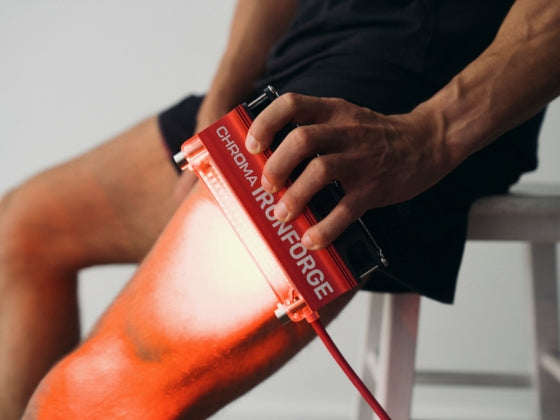
What about fans in performance devices like Ironforge?
This is the most common technical question we get.
Devices like the Ironforge, Trinity and Radiance use two small DC cooling fans.
While any electric motor produces a localized magnetic field, measurements and real-world comparisons show these fields remain in the low milligauss range at normal use distance.
More importantly, Ironforge treatments last 30–90 seconds, resulting in a total exposure that is dramatically lower than everyday devices like phones or hair dryers.
Note:
The electromagnetic field around our fans comes from a smooth, low-frequency magnetic field created by mechanical rotation, very similar in nature to the gentle variations in Earth’s own magnetic field. This is fundamentally different from the high-frequency, electrically generated EMF produced by switching power supplies or wireless devices, which involve rapid voltage changes and broad-spectrum electrical noise. Because our fans rely on physical motion rather than fast electrical switching, the resulting field is significantly lower in frequency, magnetically dominated, and does not produce the sharp electrical transients associated with modern electronic EMF sources.
Real-world EMF comparison
To put this in perspective, here are typical approximate magnetic field ranges measured very close to common devices:
Small DC fans (like Ironforge)
- 1-10+ milligauss range at normal use distance
- Exposure window is usually only a few minutes maximum per day
Cell phones (active use)
- Can exceed 50-100+ milligauss near the head or pocket
-
Used for hours per day
Hair dryers
- Often 100-300+ milligauss near the skull
- High current draw
Intensity matters.
But exposure time matters even more.
Exposure time dominates risk
Ironforge sessions last:
-
30–90 seconds
Phones:
- hours per day
- constant proximity
- often against the body
Total exposure equals intensity × distance × time.
Short, occasional exposure at low levels is not the same as constant, close-range exposure.
Panels vs targeted devices
Many traditional red light panels require:
- 20–30 minute sessions
- prolonged proximity to electronics
- repeated exposure to low frequency fields
Chroma performance devices are designed differently:
- short sessions
- targeted application
- minimal exposure window
Less time.
Less cumulative exposure.
Same biological intent.

So Are EMFs Dangerous?
The honest answer
EMFs are not inherently safe.
They are not inherently dangerous.
They are context-dependent.
What matters:
- type
- intensity
- distance
- duration
- timing
Fear without understanding removes agency.
Education restores it.
You don’t need to live in avoidance.
You just need to stop pretending everything is neutral.
Conclusion
EMFs are not the villain of modern life.
But they are also not irrelevant.
The real issue is not that EMFs exist.
It’s that modern environments stack:
- constant exposure
- poor timing
- close proximity
- and chronic stress
At Chroma, we focus on correcting what matters most:
better light
better timing
better biological alignment
Not hacks.
Not panic.
Just working with human biology instead of against it.