

Modern lighting is still compared primarily by brightness.
If two lights produce the same lux at the eye, they are often treated as equivalent.
But the human visual system does not experience light as a point measurement.
It experiences light as an environment.
This is where the brightness model breaks down.
So, in this article we will be going over:
- what lux actually measures
- why brightness alone fails to predict biological impact
- how spectrum and geometry change retinal signaling
- why large light sources feel different from point lights at the same lux
- and how Chroma designs light around biology rather than metrics
No oversimplification.
No metric worship.
Just a clearer way to think about light.
INDEX:
- What Is Lux in Lighting and What Does It Measure?
- Does Higher Lux Mean Better Biological or Circadian Effects?
- Why Lux Fails to Predict Circadian Rhythm Response
- Is 10,000 Lux Necessary for Light Therapy?
- How Light Geometry Affects Biological and Circadian Signaling
- Same Lux, Different Retinal Reality
- Why Bright Indoor Lighting Can Feel Fatiguing or Flat
- What Matters More Than Lux When Choosing a Light Source?
- Designing Light Around Biology Instead of Metrics

What Is Lux in Lighting and What Does It Measure?
Lux is a unit of illuminance.
It describes how much visible light reaches a surface or sensor, weighted to human cone sensitivity under daytime viewing conditions. It was developed to support visual performance tasks such as reading, navigation, and workplace safety.
Lux is useful.
It is also narrow.
A lux measurement:
- captures brightness at a single point
- assumes photopic, cone-weighted vision
(Photopic weighting: describes how bright light looks to vision, not how it affects biological systems.) - ignores how light is distributed across the visual field
- does not account for adaptation or pupil behaviour
Most importantly, lux was never designed to predict biological response.
Lux Measures Visual Brightness, Not Biological Response
Lux tells us how bright something appears.
It does not tell us how light behaves inside a living system.
Using lux to predict circadian or physiological effects fails because:
- biology integrates light over space and time
- non-visual photoreceptors follow different rules
- brightness alone does not describe exposure
Does Higher Lux Mean Better Biological or Circadian Effects?
Brightness is often treated as a proxy for effectiveness.
More lux equals more stimulation.
Less lux equals less impact.
This assumption feels intuitive.
It is also incomplete.
Two light sources can measure the same lux at the same distance and still have very different biological and perceptual effects.
Why the Body Does Not Respond to Brightness at a Point
Lux collapses light into a single number measured at a single location.
The retina does not.
Once light enters the eye:
- photons spread across a curved retinal surface
- different photoreceptors are engaged simultaneously
- spatial distribution alters biological weighting (Light that fills more of your visual field carries more biological weight than light concentrated into a single bright spot.)
Brightness at a point is only one variable.
Biology evaluates the whole pattern.
Why Lux Fails to Predict Circadian Rhythm Response
Circadian regulation is driven primarily by intrinsically photosensitive retinal ganglion cells (ipRGCs).
These cells operate differently from rods and cones.
Melanopsin, ipRGCs, and How the Retina Integrates Light
Melanopsin-containing ipRGCs:
(Melanopsin: acts as the eye’s environmental light sensor, tuned to daylight patterns rather than fine visual detail.)
(ipRGCs: these cells behave less like pixels in an image and more like sensors measuring how much of the scene is illuminated.)
- have large receptive fields
- spatially sum light over wide retinal areas
- integrate exposure over long time windows
- are relatively insensitive to fine spatial detail
This architecture evolved to read environmental light conditions:
- sky brightness
- day length
- gradual transitions across the day
Not focal intensity.
Why Retinal Coverage Matters More Than Lux Values
From a circadian perspective:
- a narrow beam can be bright but biologically weak
- a wide luminous field can feel gentle yet powerful
- total retinal engagement matters more than peak brightness
The circadian system does not ask how bright a point is.
It asks how much of the environment is illuminated.
Is 10,000 Lux Necessary for Light Therapy?
The number 10,000 lux appears frequently in light therapy discussions.
It is often treated as a requirement rather than a convention tied to early device design and measurement practices.
This framing oversimplifies what light therapy is actually doing.
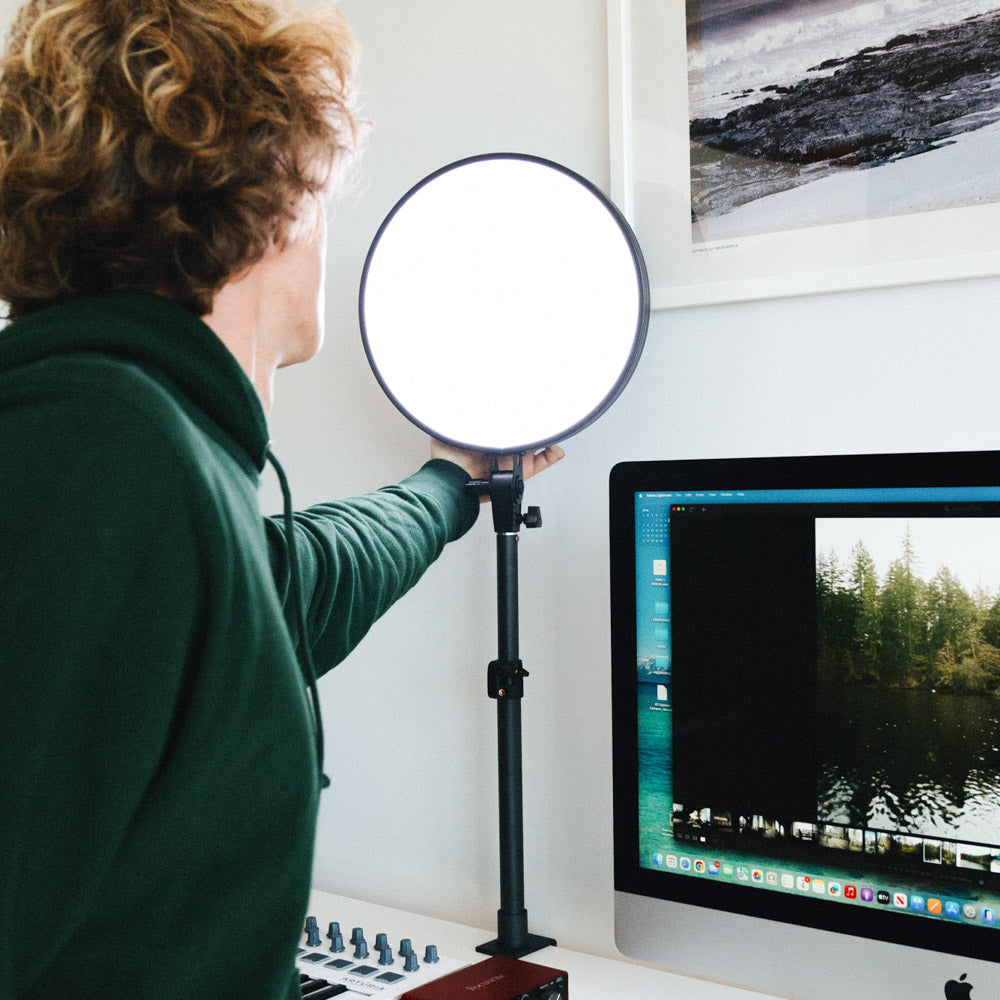
Why Effective Daytime Light Therapy Uses Large Surface Areas Instead of High Intensity
Effective light therapy devices share consistent characteristics:
- large illuminated surface area
- moderate per-point luminance
- sustained exposure duration
This design:
- reduces glare
(Glare: is the eye’s defensive response to overly intense light, often reducing how much useful light actually reaches the retina.) - limits excessive pupil constriction
- increases total melanopic stimulation
The biological effect of light therapy is driven by:
- geometry
- spectrum
- duration
Not intensity alone.
Note:
Large panels are not a requirement for all light-based interventions. Devices designed for targeted or localized applications may intentionally use smaller sources and different geometries. The principles outlined here apply specifically to light therapy aimed at broad circadian or alertness-related effects, where engaging a larger portion of the retina is biologically relevant.

How Light Geometry Affects Biological and Circadian Signaling
Geometry is one of the most underappreciated variables in lighting biology.
Two sources can deliver identical lux at the eye and still create opposite retinal realities.
Field of View and Solid Angle Matter
Lux hides angular size.
It measures how much light lands on a sensor, not how that light occupies the visual field.
A large luminous surface:
- occupies a much larger solid angle
(Solid angle: describes how much of your visual field a light source occupies, not how intense it is at a single point.) - stimulates more retinal area simultaneously
- engages melanopsin-containing ipRGCs broadly
A small point source:
- can reach the same lux value
- concentrates light into a narrow retinal region
- often feels harsher, more glaring, and less immersive
The circadian system does not respond like a lux meter.
Why Windows Often Feel More Effective Than Indoor Lights
Windows work because they are large, not because they are intense.
They:
- present a massive luminous surface
- deliver light from many angles
- change gradually over time
Even under cloud cover, daylight:
- engages the retina broadly
- allows pupils to remain more open
- delivers a stable biological signal
Not because it is brighter.
Because it is more complete.
Same Lux, Different Retinal Reality
Retinal Irradiance Is Not Point Illuminance
Two lighting setups can measure the same lux at the cornea, yet:
-
retinal irradiance distribution differs
(Retinal irradiance: describes how light spreads across the retina after it enters the eye, not just how bright it is at entry.) - peak luminance per retinal location differs
- total melanopic photon capture differs
A large source:
- produces lower peak luminance per retinal location
- delivers higher total melanopic stimulation
This explains why extended sources tend to produce:
- less glare
- better comfort
- longer tolerable exposure
- a more daylight-like subjective effect
Lux cannot see this.
The retina responds to it immediately.

Why Bright Indoor Lighting Can Feel Fatiguing or Flat
Many modern indoor environments look well-lit and still feel biologically thin.
The cause is structural, not psychological.
Glare, Pupil Constriction, and Loss of Retinal Engagement
Small, intense light sources:
- trigger local glare
- cause disproportionate pupil constriction
- reduce total retinal photon flux
Large, diffuse sources:
- maintain a more natural pupil size
- deliver more photons over time
- improve signal-to-noise for circadian pathways
This creates a paradox.
A point source can measure “bright” and still deliver less useful biological light than a gentler, more distributed source.
Brightness does not determine impact.
Adaptation does.
What Matters More Than Lux When Choosing a Light Source?
When light is evaluated biologically, priorities shift.
Spectrum
- melanopsin has its own spectral sensitivity
- photopic weighting does not describe it accurately
Geometry and Retinal Coverage
- field of view matters
- surface area matters
- distribution matters
Duration and Timing
- light is integrated over time
- circadian phase matters
Lux alone captures none of this.

Designing Light Around Biology Instead of Metrics
Most lighting systems optimise for:
- efficiency
- spatial economy
- visual performance
This leads to:
- small sources
- high intensity
- minimal surface area
- lux targets reached quickly
This works for visual tasks.
It performs poorly for biological signaling.
Why Many SAD Lamps Optimise for Brightness Over Biology
Most Seasonal Affective Disorder (SAD) lamps are designed to satisfy a brightness requirement.
They achieve this by concentrating output into a narrow blue peak around 450 nanometres (nm), allowing high lux readings from relatively small, intense sources.
This approach works visually and on spec sheets.
It is efficient.
It is easy to measure.
Biology responds differently.
Melanopsin does not respond optimally to narrow spectral spikes or point-like intensity. It integrates broad spectral input delivered across a wide portion of the retina and sustained over time.
As a result, many SAD lamps:
- prioritise peak brightness over retinal coverage
- rely on narrow blue output rather than broad, daylight-like spectra
- use small sources that increase glare and trigger pupil constriction
- deliver high lux while stimulating relatively little retinal area
The outcome is familiar.
Light that looks powerful on paper but feels harsh, fatiguing, or inconsistent in its biological effect.
How Chroma Approaches Spectrum, Geometry, and Exposure
Chroma designs light around biological interpretation rather than convenience metrics.
Rather than optimising for lux targets, designs like the Sky Portal and Sky Portal Mini are built around how the eye and circadian system actually integrate light.
This means:
- spectrum weighted for biological relevance, not visual brightness alone
- geometry treated as a first-order variable rather than an afterthought
- exposure shaped to engage more of the retina comfortably over time
In practice, the Sky Portal / Mini prioritises:
- wide-field illumination that stimulates a larger retinal area
- a balanced, day/night-aligned spectrum rather than narrow peaks
- diffuse output that limits glare and preserves natural pupil behaviour
The goal is not to overwhelm the eye with intensity.
It is to deliver a stronger biological signal by respecting how the eye actually receives and integrates light.
Note on Spectrum Design:
Unlike many SAD lamps that concentrate output in a narrow blue band, the Sky Portal and Sky Portal Mini's white channel is designed to shape which wavelengths reach the eye.
It reduces the 430–460 nm blue range commonly associated with visual strain, while increasing output in the violet and cyan bands around 415 nm and 480 nm. These wavelengths are relevant for stimulating multiple non-visual photoreceptors, including OPN3 (Encephalopsin), OPN4 (melanopsin), and OPN5 (Neuropsin), which are involved in alertness, mood regulation, and circadian signaling.
The intent is not to increase perceived brightness, but to deliver biologically useful light more efficiently and comfortably.

Lux Measures Light. Biology Reads the World.
Lux is a useful number.
It tells us:
how bright a point appears under specific conditions.
It does not describe:
how light behaves across the retina, over time, within a living system.
If two lights measure the same lux but feel different, it is because they are different.
Your biology is not confused.
It is responding accurately to information lux cannot see.