

Are Red Light Therapy Devices FDA Cleared?
Before you spend real money on a light therapy device, you want to know it's legitimate. FDA clearance sounds like the right question. It's not wrong to ask, but the answer is more interesting than a yes or no.
Here's what FDA clearance means, why most red light therapy devices don't have it, and what really makes sense to evaluate when looking for a device that will work for you.
What FDA Clearance Means
FDA clearance, specifically 510(k) clearance, means a device has been found "substantially equivalent" to a device already on the market. It's a regulatory pathway, not a safety certification, and not a review of effectiveness.
Class III devices (high-risk implantables like pacemakers and cochlear implants) go through a more intensive process called Premarket Approval (PMA). That's what "FDA approved" technically refers to. Red light therapy panels are not in that category, because they don't need to be.
For context, the product code covering therapeutic infrared and red light devices is ILY "Lamp, Infrared, Therapeutic Heating," regulated under 21 CFR 890.5500, Class II. This category is actually exempt from 510(k) premarket notification for its standard indication, "temporary relief of minor muscle and joint pain and stiffness." So many devices marketed as "FDA cleared" or "FDA registered" never went through a clearance review at all, they self-classify under an exempt category. The ones that do file a 510(k) are cleared by showing similarity to a device that already existed, not by demonstrating that the specific wavelengths work any better than others, or that the irradiance claims are accurate.
The clearance is for a device category. Not for specific wavelengths, power, or a suggested exposure protocol. Clearance is not a review of any of the variables the photobiomodulation literature shows are important.
What The FDA Cleared Badge Means In Practice
The consumer red light therapy market is largely built on OEM hardware, the same LED panel architecture developed for horticultural and greenhouse applications, with the wavelengths swapped for 660nm red and 850nm near-infrared. Dozens of brands, ranging from $49 Amazon listings to $500 "premium" devices, sell this same hardware under different names with different stickers.
Some of these carry a 510(k) clearance; many are simply registered under the exempt infrared-lamp category. Either way, the badge typically rests on a broad indication like "temporary relief of minor muscle and joint pain", something easy to claim by pointing to an existing device cleared before the modern PBM literature existed.
That clearance tells you nothing about whether the stated wavelengths are actually the wavelengths the device emits, whether the advertised power output is measured or estimated, or whether the exposure protocol is based on anything
A $69 panel with "FDA cleared" and a $500 device with "FDA cleared" are often more or less the exact same hardware, cleared for the same generic category claim. The badge doesn't distinguish them.
Red Light Has A Very Strong Safety Record
Red and near-infrared light therapy has one of the most studied safety profiles in photomedicine. The photobiomodulation literature contains thousands of peer-reviewed studies accumulated over decades. This isn't a new category, low-level light therapy has been researched since the 1960s.
The known contraindications are few: certain photosensitizing medications (some antibiotics, retinoids, chemotherapy agents), active malignancy near the treatment area, and, for high-power devices specifically, direct, prolonged application to the abdomen during pregnancy, given limited research there. As a general usage rule, don't look or gaze directly into high-power light sources, (including the sun.)
The safety record of red and NIR light doesn't come from a regulatory document, but from research itself. See our breakdown here on the enormous range of power and exposure time studied with positive results. An FDA clearance for a device category claim adds no safety assurances.
Breaking DNA bonds and damaging cellular structures are the kinds of damage done by ionizing radiation (X-rays, gamma) and UV. These energetic photons are simply not present in red and near-infrared devices. The energy levels in red and NIR light are thought to be absorbed by mitochondrial chromophores and drive photochemical reactions, not thermal or ionizing damage. The physics is categorically different.
If you have specific concerns about high-irradiance devices, we've covered that in depth here.
How To Evaluate A Red Light Therapy Device
FDA clearance isn't the question. These are:
Are the wavelengths verified?
630nm, 660nm, 670nm, 760nm and 850nm appear throughout the PBM literature because they sit at known absorption peaks for cytochrome c oxidase and other chromophores. A device claiming those wavelengths should have spectrometer data showing the actual emission spectrum. Without measurement, you're buying a label.
Is the irradiance properly measured?
Power output and irradiance measured in mW/cm² (milliwatts per square centimeter, aka power over an area) are the numbers that determine whether a session delivers a therapeutic dose. Any manufacturer can print a number on a spec sheet. Verification with spectrometer measurements, not factory or spec-sheet claims, is what makes that number meaningful. Be on the lookout for lenses in devices pumping up the irradiance claim above the lenses and only giving that single point inflated number, not what the rest of the panel delivers. This can be the difference between a meaningful device you'll keep using and something more or less equivalent to simply standing outside.
Things That Do Not Move The Needle:
Selectable or adjustable wavelength powers or sets are a big one.
Some devices allow you to set the powers on each individual wavelength in the device. Some go so far as to claim each of these combinations are good for a specific outcome. In reality, nature works in bell curves. The absence of a study on one specific wavelength only means it wasn't studied, not that it doesn't work. LED output also comes in bell curves, so a 660nm LED is delivering everything from ~650nm up through 670nm or longer. Don't get too caught up in optimizing for a specific frequency. Choose a device that has a wide range of output. Nature always delivers the entire band of red and NIR light all together, so in general the wider the better. Note that on average longer wavelengths (higher nm number) penetrate deeper into tissues.
Does the brand stand behind it?
Warranty length and trial periods are a real signal. A brand confident in their device's performance backs it with a meaningful trial window to verify it works for you, and a multi-year warranty that says the hardware is built to last. A 30-day return window on a $500 device is not confidence.
How We Look At This
Chroma devices are not FDA cleared. We don't claim they are.
What we have instead: published spectrometer measurements for every device, wavelengths chosen from the photobiomodulation literature rather than OEM defaults, and irradiance figures verified by measurement rather than manufacturer specification.
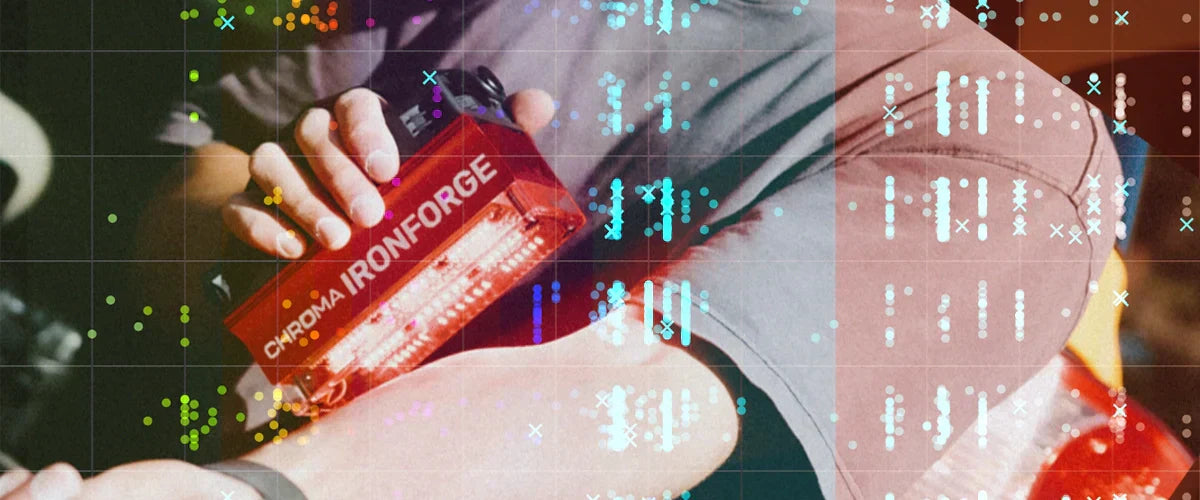
The Ironforge runs five wavelengths. 630nm, 670nm, 760nm, 810nm, and 850nm, with 850nm and the other near-infrared bands comprising roughly 75% of output for a focus on deep tissue penetration. The 148 mW/cm² figure at 6 inches is independently verified, not factory-reported; the faceplate measures 850+ mW/cm². At 200W total power draw, sessions run from 30 seconds to 3+ minutes per area rather than the 20-40 minutes typical of low-power panels.
The Radiance delivers red and NIR light and adds violet at 405nm, targeting OPN3 (encephalopsin), the most abundantly expressed opsin, a non-visual photoreceptor, in human skin. OPN3 has been studied in connection with skin health, melanin production, circadian timing, and blood vessel tone. At 50W, this device delivers roughly five times the power of standard LED face masks, allowing 30-90 second exposure per zone. Spectrometer data at multiple distances is published and available.
Neither device is built on OEM greenhouse hardware. We custom-built both, and each has the measurement data to back what it claims. All Chroma devices come with a 100-day satisfaction guarantee and a 5-year warranty.
FDA clearance is nice to know, it just doesn't answer what you actually care about. The FDA device category framework and the wellness science aren't the same thing. Buyers who want to understand what they're purchasing should look at wavelengths and output verification. The rest is marketing.
Common Questions
Is red light therapy FDA approved?
No, and that's not the right category. FDA approval (PMA) applies to Class III high-risk implantable devices. Red light therapy panels are Class II at most, and most wellness-use devices don't pursue any clearance pathway at all. "FDA approved" doesn't apply here, and a device claiming it should raise questions.
Does FDA clearance mean a device is safe?
No. 510(k) clearance means a device is substantially equivalent to something already on the market. It says nothing about safety testing, wavelength accuracy, or whether the device will actually do anything useful. The safety record for red and NIR light comes from 30+ years of peer reviewed research, not a regulatory document.
Do I need an FDA cleared red light therapy device?
No. Clearance isn't required and doesn't predict performance. What predicts performance is irradiance at use distance, and verified wavelengths.
References
-
U.S. Food and Drug Administration. "510(k) Premarket Notification." FDA.gov. The 510(k) pathway requires demonstration of substantial equivalence to a legally marketed predicate device; clearance is not equivalent to approval.
-
U.S. FDA Product Classification Database. Product Code ILY: "Lamp, Infrared, Therapeutic Heating." 21 CFR 890.5500. Class II — exempt from 510(k) premarket notification for the standard indication ("temporary relief of minor muscle and joint pain and stiffness").
-
Chung H, Dai T, Sharma SK, Huang YY, Carroll JD, Hamblin MR. "The Nuts and Bolts of Low-level Laser (Light) Therapy." Annals of Biomedical Engineering. 2012;40(2):516-533. Comprehensive review of PBM safety and efficacy literature. DOI: 10.1007/s10439-011-0454-7.
-
Hamblin MR. "Mechanisms and applications of the anti-inflammatory effects of photobiomodulation." AIMS Biophysics. 2017;4(3):337-361. Overview of PBM mechanisms including cytochrome c oxidase as primary chromophore. DOI: 10.3934/biophy.2017.3.337.
-
Enwemeka CS. "Intricacies of Dose in Laser Phototherapy for Tissue Repair and Pain Relief." Photomedicine and Laser Surgery. 2009;27(3):387-393. Addresses dosing parameters, measurement accuracy, and the evidence basis for therapeutic fluence ranges. PMID 19473073. DOI: 10.1089/pho.2009.2503.
-
21 C.F.R. § 807.97. "Any representation that creates an impression of official approval of a device because of complying with the premarket notification regulations is misleading and constitutes misbranding." Devices with 510(k) clearance may not be marketed as "FDA approved."