

The Uncomfortable Truth About This Industry
Something most red light therapy companies don't want you to think about too hard is the vast majority of devices on the market come from the same handful of factories.
The process works like this. A company finds a manufacturer. They pick a stylish panel off the catalog. They choose their wavelengths (usually 660nm and 850nm because that's what's most common and cheapest to produce). They slap their logo on it, build a nice website, and start running ads.
The device you're buying from Brand A is often physically identical to the one from Brand B, C, and D. Different stickers, same guts.
This of course doesn't mean those devices don't work. Red and near-infrared light at the right wavelengths above some fairly low irradiance threshold will produce a biological response regardless of whose name is on the case.
Physics doesn't care about branding.
But this does mean when you're comparing specs, you're often comparing MARKETING rather than engineering. And when every brand is pulling from the same parts bin, the actual differences come down to things most companies don't talk about.
Because they can't.
If you're still exploring whether red light therapy is right for you, start with our general guide to red light therapy benefits.
What Really Matters in a Red Light Therapy Device
If you're going to spend money on a device you'll use for years, these are the specs that determine whether it performs as you’d expect, and the questions most brands hope you don't ask.
I. Irradiance (Power Density)
This is the single most important spec, and the most commonly misrepresented.
Irradiance measures how much light energy hits a given area per second, expressed in milliwatts per square centimeter (mW/cm²). Higher irradiance means more photons reaching your tissue in less time.
Higher irradiance means shorter sessions for the same biological effect.
A device with low irradiance might deliver the right wavelengths, but require you to stand in front of it for 20 to 40 minutes to accumulate a meaningful exposure. Most people won't do that consistently.
But consistency is what produces results.
What to watch for: Many light panel companies measure irradiance at the surface of the device rather than at a realistic treatment distance for their device. A panel might claim 200 mW/cm² measured with the sensor pressed against the LEDs. At a typical treatment distance for these devices, that number drops dramatically.
The Chroma Ironforge delivers 148 mW/cm² at 6 inches and over 850 mW/cm² at the faceplate. These numbers were independently verified by third-party testing.
That's not a small difference. It's a different category of device entirely.
II. Wavelength Selection
Match your ratio to your intended use.
Most devices offer 660nm (red) and 850nm (near-infrared) because those are the most cost-effective LEDs to manufacture. They're reasonable choices.
Both fall within the therapeutic window, but they're chosen for economics, not optimization. Further, a 50:50 blend of these LEDs actually leaves you with closer to a 60:40 distribution due to the lower photonic efficiency of NIR LEDs.
We choose to optimize for biology instead of cost.
The Ironforge uses a custom configuration:
850nm – 50%
810nm – 12.5%
760nm – 12.5%
670nm – 12.5%
630nm – 12.5%.
That NIR-heavy ratio is deliberate. It's designed for deep tissue work on joints, muscles, and connective tissue.
The point: a company that designs its own devices can match the wavelength profile to the use case. A company rebranding catalog greenhouse panels gives you whatever the factory had available.
III. Build Quality and Thermal Management
LEDs generate heat. The harder you drive them, the more heat they produce. And heat is the enemy of LED lifespan and consistent output.
This is where off-the-shelf panels hit a wall. To keep costs down, most incorporate minimal thermal engineering. That limits how hard you can drive the LEDs before they overheat and degrade. The result: moderate power output with moderate build quality, and questionable longevity.
A clear red flag is a device with a plastic housing. Worse are small plastic battery powered devices. These often deliver far less red/NIR light than simply standing outside on an overcast day.
Custom thermal management along with higher quality ceramic LEDs allows us to drive LEDs harder, maintain consistent output, and build a device that delivers the same spectrum and irradiance on day 3,000 as it did on day 1.
This is a major reason why the Ironforge can deliver 50x the spectral radiosity of a conventional panel in a fraction of the size. It's not magic. It's thermal engineering that most companies never invest in because they don't build their own hardware.
IV. Treatment Area vs. Your Actual Goals
This is where most buyer's guides steer you toward the biggest, most expensive panel.
Let's go the other direction.
Full-body panels have their place. But for most people, especially if you're using red light therapy at home and targeting specific areas like a tired knee, a stiff shoulder, your face, or your scalp, a high-irradiance targeted device is more practical and more effective per dollar spent.
Think about it this way: a large panel spreads light across your entire body at low to moderate intensity. A compact, high-power device concentrates that same total energy (or more) exactly where you need it. If you know where your focus areas are, precision beats coverage.
The Ironforge was designed around this insight. The entire output of a large panel, compressed into something the size of a brick. A 90-second targeted session can deliver the same dose to a specific area that would take ~2 hours with a conventional greenhouse style panel.
That said, if your goal is whole-body wellness or you want to cover large areas like your back, a panel format could make sense. But, physics is once again on the side of a small powerful device.
Given light spreads out with distance, using the Ironforge at a moderate distance dramatically increases exposure area while bringing the irradiance down closer to that of a standard panel.
We could call it a two in one, but it's just how physics works. No fancy marketing necessary.
V. Flicker
A spec that sounds technical but matters for daily use.
Many LED devices use pulse-width modulation (PWM) i.e. FLICKER to control brightness. Many people are sensitive to this, especially at close range. Well-engineered devices use constant current drivers that eliminate flicker. If a brand doesn't mention flicker, they probably haven't addressed it. (Even if they do, high speed PWM is often falsely marketed as "flicker free.")
A quick note on common marketing lies in red light therapy.
There's another number worth questioning: total wattage. Many brands advertise total power output by adding up the peak rated wattage of every LED in the device. A panel with 200 LEDs rated at 3 watts each becomes a "600 watt device." Sounds impressive on a spec sheet. But leads too many people to think red light therapy is a scam.
In reality, LEDs are almost never driven at their peak rating, doing so generates excessive heat and drastically shortens their lifespan. The actual power draw from the wall is often a fraction of the advertised number. A "600 watt" panel might pull only 200 watts from the outlet.
Headline numbers are often pure marketing, not reality. If a company advertises total LED wattage but doesn't publish actual wall power draw or irradiance at distance, they're telling you the number that sounds best rather than the number that matters.
When choosing the best red light therapy device, irradiance at treatment distance matters more than headline wattage claims.
What reaches your tissue is what counts. Everything else is decoration.
The Real Question: Who Designed This?
Here's the filter that cuts through all the noise in this market:
Was this device designed by engineers solving a specific biological problem? Or was it selected from a catalog by a marketing team building a brand?
Most red light therapy companies are, at their core, marketing operations. They don't design hardware. They don't have engineers on staff. They source devices, commission some content, run ads, and compete on price and aesthetics. There's nothing inherently wrong with that model, it's how most consumer electronics work.
But light therapy is different. The dose-response relationship is real. Wavelength selection matters. Irradiance at treatment distance matters. Thermal management affects long-term output. These aren't cosmetic details. They're the variables that determine whether the device does what the research on photobiomodulation says it should.
Chroma was founded by an engineer and run by a few others. The Ironforge was designed from scratch, from the LED configuration to the thermal management to the drive electronics.
This is the reason the Ironforge delivers irradiance levels that no catalog device can match, in a form factor that makes daily use realistic, at a price point that respects the fact that you're buying a tool for life, not a lifestyle accessory.
Red Light Therapy Panels, Masks, and Other Devices
The device format and spectrum should follow your goals. Here's how to think about it.
Handheld / targeted devices are ideal for joint support, muscle recovery, and focused skin areas. The Ironforge and Ironforge Mini live here. If you want one device that handles the most use cases with the least time commitment, this is where to start.
Face-specific devices target skin health, collagen support, and complexion. Most masks on the market run their LEDs at extremely low power to avoid overheating (they have no cooling systems and are made of plastic), resulting in weak outputs that require 20+ minute sessions to sorta kinda notice something after a few weeks. The Chroma Radiance was engineered differently with active thermal management allowing higher driven power, so you get meaningful energy delivered to your skin in 90 seconds of sweeping instead of sitting with a plastic mask on your face for a quarter of an hour. The Radiance also focuses on violet light for the wide range of skin and circadian benefits.
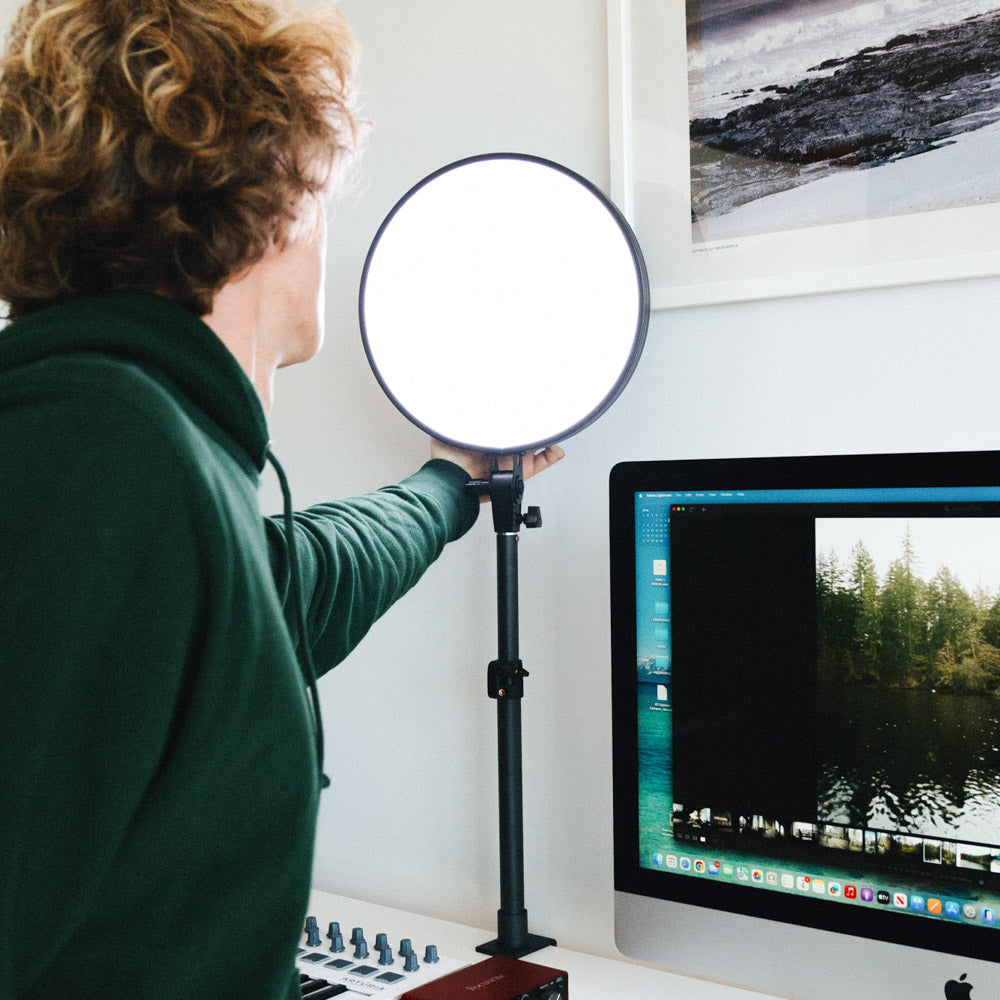
Circadian lighting is a different category entirely. Devices like the Chroma Sky Portal and Red Portal aren't photobiomodulation tools, they're workspace targeted light sources designed to support your circadian rhythm by providing the right spectral profile at the right time of day. Most "SAD lamps" and daylight simulators use spectral profiles that don't match what the research shows about circadian biology.
Learn more about how light affects sleep in our complete guide to red light therapy and sleep. This is an area where Chroma stands alone.
What's the Best Red Light Therapy Device?
It depends entirely on what you need it for. But here's the honest answer: the best light therapy device is the one that delivers clinically relevant irradiance at the wavelengths that match your goals, And of course, one you'll use consistently.
For most people, a high-irradiance targeted device handles the widest range of use cases in the least amount of time. If you already know you need something specialized (skin, circadian, portability) the right device narrows from there.
Here's how Chroma's lineup maps to real world goals:
|
Device |
Best For |
Irradiance |
Typical Session |
|
Joints, muscles, whole-body, recovery |
148 mW/cm² @ 6" / 850+ mW/cm² at faceplate |
1–3 min/area |
|
|
Same as Ironforge, travel-friendly |
Same faceplate irradiance, smaller body |
1–3 min/area |
|
|
On-the-go, battery powered |
~85 mW/cm² at faceplate |
5–15 min/area |
|
|
Skin glow, collagen, complexion, acne support |
Engineered for 90-sec sessions |
30–90 sec/area |
|
|
Circadian rhythm, sleep, daytime energy |
Workspace circadian lighting |
All day/evening |
A Simple Framework for Deciding
Rather than comparing spec sheets across a dozen brands, ask yourself three questions:
I. What am I trying to support? Joint comfort, muscle recovery, and deep tissue wellness benefit from high-irradiance NIR. Skin thrives on red and violet wavelengths. Daytime energy and sleep need circadian-appropriate lighting throughout your day. The answer narrows your device type immediately.
II. How much time will I realistically commit? Be honest. A 5-minute daily habit sticks. A 30-minute daily habit usually doesn't. Either passive all day devices like our Sky Portal, or higher irradiance devices like the Ironforge or Trinity fit nicely into real life.
III. Who designed this, and can they explain why? If a company can't tell you why they chose specific wavelengths, what irradiance their device delivers at a realistic distance, or how their thermal management works… they probably don't know. They're selling someone else's hardware with their name on it.
Where Chroma Fits
We're not trying to be the biggest brand in this space. We're trying to be the most serious one. We’re building for generations to come.
Every Chroma device is designed in-house. The build quality reflects the fact that these devices are engineered by people who use them daily, not selected by people who sell them.
If you're looking for the most powerful targeted red light therapy device available, the Ironforge is it. Independently verified as the highest-irradiance handheld device on the market. If you travel frequently, the Ironforge Mini delivers about 60% of the faceplate irradiance in a smaller body, and the Chromatorch offers a portable solution that’s more powerful than most others in the category
If skin is your primary focus, the Chroma Radiance is engineered to replace underpowered LED masks with 90 second sessions that deliver meaningful energy to your skin, including 405nm violet light targeting opsins that no other consumer device addresses.
If sleep and circadian health matter to you, the Sky Portal is a zero-flicker circadian desk lamp that provides biologically appropriate light for both day and evening use. Nothing else on the market does this.
And if you want to talk to a real person about which device fits your situation, call us. A human answers.
+1 (844) 374-6866 | hello@getchroma.co
This guide is for educational purposes. Chroma devices are general wellness products designed to support your body's natural processes. They are not medical devices and are not intended to diagnose, treat, cure, or prevent any disease. If you have a medical condition, consult your healthcare provider.
Frequently Asked Questions
How do I know if a red light therapy device is legitimate? Look for independently verified irradiance at a stated distance (not just at the surface), specific wavelength data, and transparent manufacturing details. If a brand can't tell you who designed their hardware or where it's made, that's worth noting. If it’s battery powered and made of plastic, there’s a good chance just standing outside is much more effective.
Is more expensive always better? Not necessarily. Price should reflect engineering quality, irradiance output, and build durability, not just brand positioning or aesthetics. A well-designed compact device can outperform a larger, more expensive panel for targeted applications, and match it for larger area coverage.
Do I need a full-body panel? Most people don't. A high-irradiance targeted device handles the majority of use cases in less time and at a lower price point, and can be used at a distance for a larger area of exposure.
How long until I see results? This varies by application. Many people notice changes within a few weeks of consistent use, though individual experiences vary. Skin improvements typically emerge over 4 to 8 weeks. Hair density changes can take 16+ weeks. The common thread in most every positive study: consistent use over time and enough total energy delivery to matter.