

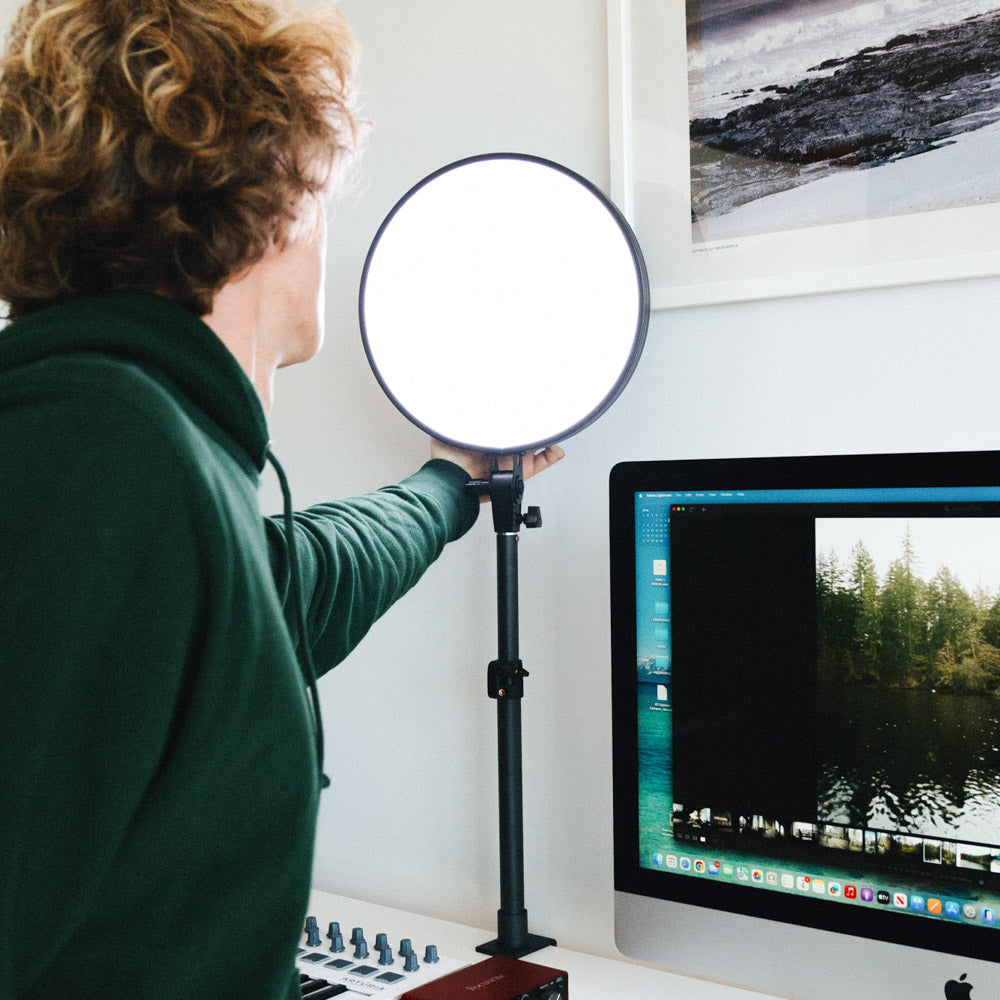


You're Not Getting Enough of the Right Light
If you work indoors (like most of us do now) you're spending the majority of your waking hours under light that looks fine visually, but is biologically incomplete and far from ideal. That sluggishness, lack of motivation, and general feeling of doom is more than just not loving corporate life and more than the winter blues.
I'm here to tell you your light environment is a big part of these feelings and it's one of the easiest things to change.
Standard LED lighting looks white to your eyes. But compared to sunlight, it's missing key parts of the spectrum our bodies are literally built for. The parts that make us feel alive, motivated, and allow us to feel a deep sense of fulfillment.
The most important gap is in the cyan range (around 480nm, or sky blue). This is the exact range our body's light sensors are most sensitive to. This range drives alertness, mood, hormone timing, and the sustained constriction of your pupils that naturally protects our eyes from harsh light.
Most basic white LEDs have a huge gap in output in this range. The lighting industry calls this the "cyan gap."
The other missing component is violet light. This range activates a separate set of light-responsive opsins throughout your body that are studied to play roles in skin health, metabolism, eye development (and health), and local tissue signaling. Sunlight is rich in violet. Indoor lighting provides essentially none.
Our bodies are indoors, but they still expect the sky. This mismatch is quietly messing with the wellness of nearly everyone who spends hours indoors.
This Is Not a SAD Lamp
People often compare our Chroma Sky Portal to a SAD lamp. I get why that's a natural comparison… both sit on a desk and both involve bright light. But the comparison ends there.
SAD lamps were designed in 1990, over a decade before scientists discovered the specific biological light sensors that drive circadian and mood responses.
The standard "10,000 lux for 10 min" was set using a brightness metric (photopic lux) that we now know is a poor predictor of how light really affects biology.
We now know what matters isn't raw brightness but the spectrum of the light. Specifically, how much melanopic energy the light delivers - the wavelengths these non-visual light sensors respond to most.
In one study, light at only 100 lux (fairly dim visually) with the right spectral profile performed comparably to a 10,000 lux standard white light.
SPECTRUM is the key. Brute force brightness was the best we could recommend before we understood the biology of melanopsin. Now we know better and can do better.
So we did. (And somehow are still one of the only light companies doing so!)
The Sky Portal isn't designed to blast you with 10,000 lux. It's designed to deliver the wavelengths your biology needs in a form factor you'll use every day without thinking about it. We think of it as a portal to a natural outdoor environment, giving your workspace the light your body evolved to expect.
The graph below depicts the comparison of spectral irradiance and wavelength distribution from 3 differing light sources (Monitor, Monitor + Sky Portal, Sky Portal). The red, green, and blue curves show how each source emits energy across different wavelengths, revealing distinct peaks and gaps that define their biological and visual impact.

What the Sky Portal Does Differently
We Fill in the Cyan Gap
The Sky Portal's daytime white channel includes a boosted 480nm sky blue component that directly targets the peak sensitivity of these circadian light sensors we mentioned. Standard white LEDs have almost no output right where this signal should be strongest.
This has a secondary benefit worth understanding. When sky blue light activates these non-visual light sensors in your eyes, it drives a sustained pupil constriction.
Your pupils get smaller and stay smaller.
This means the amount of junk light from your screen (and other lights in the room) reaching your retina is meaningfully reduced.
To be clear: adding in more beneficial light actively reduces the level of harsh dark blue light that makes it to your retina.
This is a natural built-in protection mechanism.
We Restore Violet to Your Light Environment
The Daytime White channel also includes boosted violet light. This targets other opsins (light sensors) that modern indoor environments leave completely unstimulated.
Our biology has receptors tuned to violet light, and indoor life provides none. Studies link violet light exposure to everything from eye health to metabolic signaling. The Sky Portal gives your body back some Violet we’re otherwise missing.
We Remove the Harsh Dark Blue Light
While boosting the wavelengths your biology needs is a solid start. There’s only so much power we can practically push through this device.
So we cut out the junk light as well.
Our Sky Portal daytime white spectrum nearly eliminates the 430nm to 450nm harsh dark blue range. This is the band that sits at the peak of the blue light hazard function (the established measure of which wavelengths carry the most phototoxic potential).
Less spectral waste. Less harsh blue light. More of what your body can use.
The resulting light environment of a monitor + a Sky Portal is remarkably closer to a natural outdoor light environment, with the Sky Portal filling in violet and cyan, and not contributing more harsh dark blue.
We’ve Added Deep Amber for Evenings
The Sky Portal isn't just a daytime light. Its deep amber channel (boosted with 660nm red) offers balance to the Daytime White channel during the day and works as a usable room light for evenings. The spectrum is designed to minimize circadian impact while remaining usable.
You can read, work, and wind down without your evening illumination suppressing melatonin by telling your brain it's still daytime.
The blend between daytime white and deep amber is adjustable, so the light can shift with your day. Mostly daytime white in the morning. A warmer blend in the afternoon. Pure deep amber after sunset. Adjust to your visual and circadian comfort all day.
After a week or so, you’ll begin to feel the stimulation you want during the day, and will naturally avoid it in the evenings.
How to Use Your Sky Portal
This is the simplest part.
Morning and daytime: Turn it on. Use the Daytime White setting and blend in some Amber to a comfortable level. Don't overthink it. Indoor environments are nowhere near the intensity of outdoor light, so more is better during the day. Go outside whenever you can (nothing replaces sunlight!), but when you're at your desk, the Sky Portal replaces some of the key signals your body is missing.
Afternoon: Blending in more of the amber channel. This isn't strict, it's about gradually shifting your light environment as the day winds down. Adjust to a comfortable level, from 60-10% Daytime White.
Evening: Switch to pure Deep Amber and dim it as low as comfortable. You can even spin the light to bounce off a wall for softer, more diffuse output. Pair with your Nightshades if you're using screens.
During the day, this is more of an ON/OFF situation. Indoor environments are already so far below outdoor light levels that we’re simply correcting a deficit, not adding excess. Turn it on in the morning. Use it all day. Transition to pure amber in the evening. That's the whole protocol.
The Bigger Picture
We built the Sky Portal because the indoor light problem isn't going to fix itself. Building codes specify minimum brightness for visual tasks. They don't specify spectral quality for biological needs. The lighting in your office, your home, and your hotel room was all designed to help you see, not to help your body know it’s daytime.
The people searching for bright light therapy for seasonal depression, bright light therapy for seasonal affective disorder, or just a better SAD lamp, they're looking for the right thing. Light matters. The science is clear on that. But the 10,000 lux box you stare into for 30 minutes isn't the only way to get there, and it absolutely isn't the best way anymore.
Instead of a therapy session, the Sky Portal is an environment upgrade. Instead of brute force brightness, we focus on the spectrum. Instead of 30 minutes of treatment, it's the quality of light you work under all day, every day.
Going outside is always the best answer. But for the hours you can't, the Sky Portal brings the parts of the sky that matter most to daytime wellness to the place where you need them most.
Want to learn more about how light affects your body? Read our complete guide to red light therapy benefits, our blue light glasses guide, or our guide to beating jet lag with light.
The Sky Portal is a general wellness lighting product designed to provide spectrally complete indoor illumination. It is not a medical device and is not intended to diagnose, treat, cure, or prevent any disease, including seasonal affective disorder or seasonal depression. The research cited in this article refers to the broader field of circadian photobiology and light therapy, not to this specific product. If you have a medical condition, consult your healthcare provider.
Frequently Asked Questions
Is this a bright light therapy lamp for seasonal depression? The Sky Portal is not a medical device and isn't designed to treat seasonal affective disorder or any medical condition. What it does is provide spectrally complete indoor light. It fills the cyan and violet gaps that standard lighting misses so your workspace delivers the biological light signals your body expects during the day. The underlying circadian science is well-established: light spectrum matters for alertness, mood, and biological timing.
How is this different from a SAD lamp? SAD lamps use raw brightness (10,000 lux of standard white light) to deliver a circadian signal through sheer intensity. The Sky Portal uses a spectrally engineered spectrum that targets the specific wavelengths your non-visual light sensors respond to, while removing the harsh dark blue that standard LEDs concentrate in. Research shows spectrally optimized light at a fraction of the lux can match the circadian effects of 10,000 lux standard white light.
Does this help with blue light from screens? Yes, in two ways! First, the Sky Portal's daytime spectrum provides zero output in the harsh dark blue range (430–450nm), so it doesn't add to the blue light hazard load from your screens. Second, the boosted sky blue (480nm) component drives sustained pupil constriction, which reduces the amount of blue light from screens that reaches your retina. Your pupil is a natural aperture. When it's smaller, less of everything gets through, including the harsh blue light from your monitor.
Can I use it all day? Yes. During the day, your indoor light environment is so far below outdoor levels that more spectrally complete light is a correction, not an excess. Use the daytime white channel freely from morning through afternoon.
When should I switch to the amber channel? Around sunset, or 1 to 3 hours before bed. The transition doesn't need to be precise. The goal is to gradually shift your light environment from daytime-supporting to sleep-supporting as the evening progresses. Dim it as low as comfortable, or spin it to bounce off a wall for even softer output. Listen to your body and experiment to find the transition time that works best for you and your sleep schedule.
Does the cyan light make the room look blue? No. The Sky Portal produces a natural-looking white light during the day. The cyan and violet components are balanced within the spectrum so the overall appearance is clean and neutral. It looks (and feels) like good light because it is good light.
I already have bright overhead lights. Do I still need this? Probably. Standard overhead LEDs suffer from a cyan gap and provide zero violet light. They may also concentrate their blue output in the harsh dark blue range rather than the biologically useful sky blue range. The Sky Portal fills the specific spectral gaps that overhead lighting misses, positioned at desk level where it reaches your eyes most effectively.
How is this different from sitting near a window? A window with direct sunlight is better. Nothing replaces the full solar spectrum at outdoor intensity. But windows face one direction, clouds happen, seasons change, and many desks aren't near windows at all. Modern windows even block a large portion of the violet and deep red ranges. The Sky Portal provides a reliable, consistent source of the wavelengths your biology needs most, positioned exactly where you spend your working hours.


