

When setting out to build truly superior lights for circadian biology, we kept arriving at the same fork in the road.
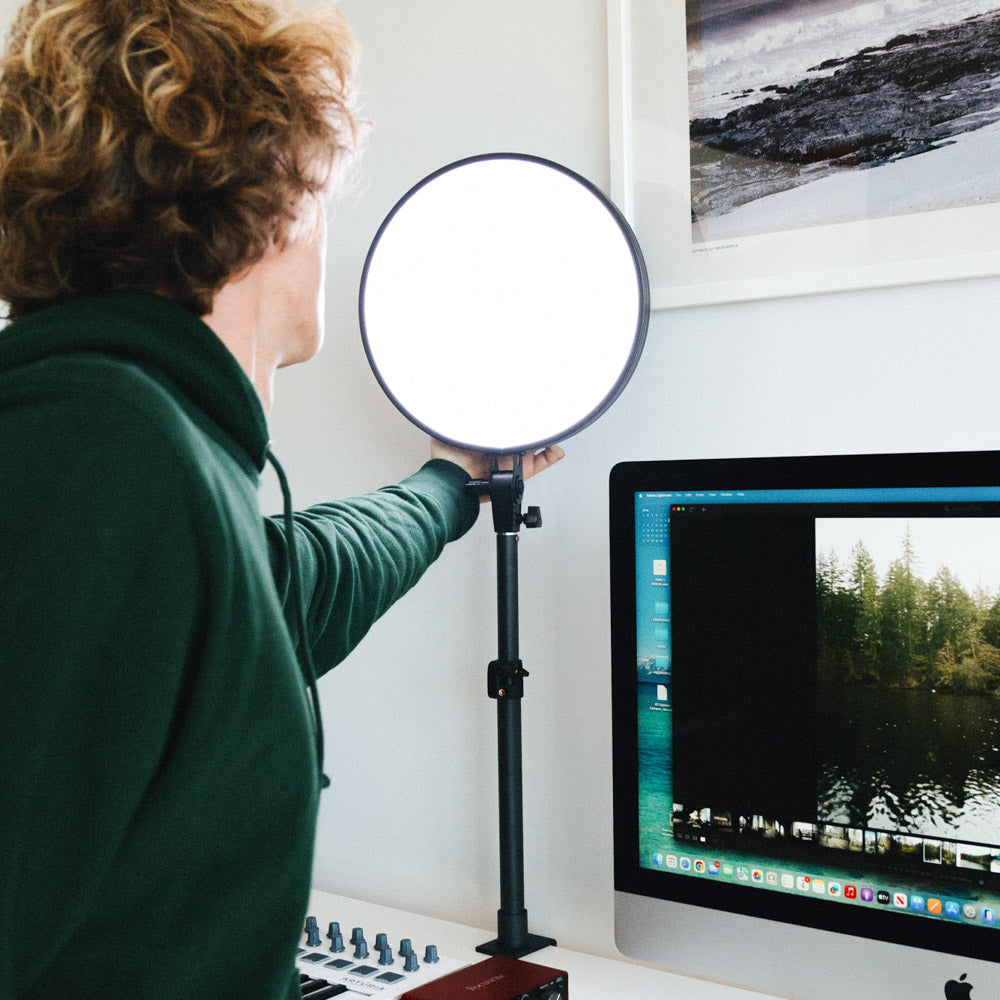
Option one: put biology first. Ask one important question: "what will have the most biological impact on the circadian rhythm of the person sitting at this desk?" Follow that question and you end up with the Sky Portal. Arguably the strongest circadian light out there for this use case. Very low blue-light hazard. A custom deep amber channel that balances the daytime signal beautifully as the hours tick by. The intent is somewhat utilitarian, but the output feels excellent. It's stimulating, alive, and warm in the evenings. It works brilliantly for the one person at the desk.

Option two: match the sun. A different question entirely. "How do we bring the full fidelity of sunlight inside?" Not targeting one person, but lighting a whole room. The goal shifts from biological compression to spectral honesty. From maximizing circadian punch to replicating the source itself. Illumination is now the focus.
That second question is why we built the Skylight. Yes, it's still a strong circadian driver, but instead of cramming maximum biological impact into a workspace, we asked how closely we could replicate the actual spectrum of the sun. Every band. From violet through visible, deep into red, and as far into near-infrared as our power budget allowed while keeping the brightness significant.
The design principle for the Skylight: bring the sun inside in its full fidelity. The real thing, or as close as we can get. 550 watts of power draw, split over 3 thoughtfully designed independent spectrums did the trick.

We did a hell of a good job. But to understand just how well, you first need to understand why the metric almost everyone uses to talk about light quality is the wrong metric entirely.
Brighter Lamp Review: 95 CRI, 72 SSI
One of them looks and feels like a window. The other looks and feels like a hospital hallway. If you're comparing the Brighter Lamp to alternatives, the Brighter Lamp leaves a lot to be desired.
CRI does not measure how close a light source is to sunlight. You'll read that all over reddit, but it's just straight wrong.
CRI was created in 1965. The era of incandescent bulbs and cool white fluorescents, a time when "does this light make the supermarket produce look roughly fresh?" was a meaningful design question.
The CRI test works like this: take eight pastel color samples, soft pinks, muted greens, dusty blues, a neutral yellow. Compare how they appear under the test light versus a color-temperature-matched reference. Average the eight differences. Report one number from 0 to 100.
Useful for retail lighting. Useless for trying to bring the sun indoors.
It's easy to game too. An LED tuned to nail those eight chips scores 95 while leaving vast regions of the spectrum lacking. The bands that matter most for biology sit entirely outside the scoring window: violet, deep red, near-infrared. The harsh blue spike near 450nm that sits right beside the blue light hazard action spectrum peak. The cyan gap between 470–500nm that most commercial LEDs quietly skip.
A bulb can reach 95+ CRI with a spectrum that looks nothing like the sun. (Scroll down to see an interactive chart comparing spectrums!)

This is where the marketing goes wrong. People buying these high CRI lights care about fidelity and light quality, but have been tricked into looking at an exceptionally poor metric. These are people who've read enough to know light affects their mood, sleep, and productivity, and are spending real money trying to fix it.
The "Brighter Lamp" is a useful example. It's a 560-watt, "60,000-lumen" floor lamp that launched in late 2025, marketed to exactly that audience. Their claim: "photography-grade LEDs matching sunlight's CRI — 95+." Some of their marketing goes so far as to say "Perfectly Mimicking The Sun's Spectrum." No spectrum graph is published on their site. No SSI score. No melanopic data. The CRI number and the lumen count are the entire technical case. Aside from stretching their claims, they promote using this light at night in nearly all their ads, while saying things like "The right light at the right time" and "Helps regulate your circadian rhythm" We'll address this terrible circadian advice down below.

The CRI claim is designed to imply: this light renders the world the way sunlight does, from skin tones to warm colors, the full fidelity of what the eye evolved under. The phrase "photography-grade" does the heavy lifting. It sounds measured and precise, like something a scientist might say.
But CRI 95 doesn't even guarantee good color rendering!
Deep red, or "R9" in the IES lingo, is the band that determines how warm tones and skin appear. It's the critical sample for photography, for portraiture, for any light that needs to make a human face look alive rather than flat and sickly. R9 is not in the standard 8-chip CRI average. It's a bonus metric, reported separately when companies bother to report it at all.
A lamp can score CRI 95 with R9 far below 90 , or even near zero. Skin can render flat. Warm tones drain out, but the CRI badge still says 95.
"Photography-grade" is a hollow claim if the grade skips the band that photography depends on most. Similar marketing nonsense to "clinical" or "professional" grade.
CRI 95 is not "identical to sunlight." It's not even a guarantee of good skin tone rendering. It's a 60-year-old color accuracy test for supermarket produce, applied by marketers to a problem it was never built to solve.

One more term worth examining: "full spectrum." It sounds scientific, precise, even rigorous. It has no standardized definition. No regulatory threshold. No test to pass. Any manufacturer can print it on a product without publishing a spectrum graph, without measuring violet, deep red, or near-infrared output, without demonstrating anything at all. CRI 95 and "full spectrum" are frequently paired in lighting marketing to imply sunlight-matching quality. Neither one measures it.
SSI: measuring the spectrum itself
The Academy of Motion Picture Arts and Sciences has a different problem. Their lights need to look like the sun on camera, they need actual spectral similarity, not color-chip accuracy. So they built a different metric.
The Spectral Similarity Index compares entire spectral curves, point by point across 380nm to 780nm against a reference illuminate like daylight. The result is one number, 0 to 100. And the scale compresses hard at the top:
- ~60-75 — typical commercial LED against matched daylight
- 80 — genuinely rare; broadcast-grade
- 90 — excellent; tracking the solar curve closely
- 94+ — rarefied; effectively indistinguishable from the reference
Each point above 90 is dramatically harder to earn than the last. The gap from 80 to 94 is not "17% better." It's a fundamentally different spectral profile.
Film production targets SSI above 80 because anything less lies to the camera. The metric was built for people who can't afford to be lied to by their light.
The Skylight, measured
Every number below is computed directly from the raw spectral power distribution of the Chroma Skylight white channel, with the smallest possible touch of the amber channel added in. Measured with an OHSP-350UV spectrometer, not pulled from a data sheet.
| Metric | Value |
|---|---|
| CCT | 4,915 K |
| SSI vs CCT-matched daylight | 95 |
| SSI vs D55 (5500K) | 92 |
| CRI Ra | 98.7 |
| R9 (deep red) | 99.1 |
| TM-30 Rf (fidelity) | 98.2 |
| TM-30 Rg (gamut) | 101.0 |
SSI 95 is the headline. Measured against the daylight curve at its own color temperature, the Skylight's spectrum is effectively indistinguishable from sunlight.
Note: TM-30 is a much better tool for light fidelity, covering 100 samples, another metric most lights will not share. That said, SSI is still superior when talking about spectrum similarity to sunlight.
High CRI. But what does the spectrum look like?
What a real sunlight-like spectrum contains
Three bands matter most, and they're the two bands almost every commercial LED skips: violet (400–420nm), cyan (~470-490nm) and the deep red / near-infrared shoulder (620nm and up).
Every source below is normalized to equal visual brightness (1000 lux, a well-lit indoor space). Values show the energy in each band as a percentage of what actual daylight delivers at the same brightness.
Daylight = 100%. That's the target. Anything less is a band where the light is short-changing you.
| Band | Daylight (D55) | Skylight | 4100K cool LED | Brighter Lamp |
|---|---|---|---|---|
| Violet 400–420 nm | 100% | 93% | 4% | 11% |
| Dark blue 420–460 nm | 100% | 92% | 92% | 91% |
| Melanopic cyan 470–490 nm (Main Circadian Driver) | 100% | 90% | 38% | 55% |
| Green 500–570 nm | 100% | 97% | 93% | 85% |
| Deep Red 620–700 nm | 100% | 98% | 63% | 59% |
| Near-infrared 700–780 nm | 100% | 62% | 4% | 9% |
The Skylight tracks sunlight across every visible band, landing between 90–98% in each. Deep red matches daylight at 98%. Violet, dark blue, and cyan sit just under (90–93%). Green is 97%. Near-infrared falls to 62% (power constraints force tradeoffs!) but the Skylight still delivers five to fifteen times what a standard LED produces past 700 nm. (The independent amber and deep red channels were not running during this measurement. They extend the deep red output further still.)
At the same visual brightness, the Brighter Lamp nearly matches sunlight's dark blue. It's the wrong band to match. It delivers only 55% of sunlight's melanopic cyan, the 470–490nm range, the main circadian driver, and less than a tenth of sunlight's violet and near-infrared. Plenty of blue. Just not the blue that matters. Unbalanced, and overstated.
Same lux. Fundamentally different spectrum. CRI missed every one of those differences. SSI didn't.

Why the spectrum matters
Violet activates OPN5 and OPN3 — photoreceptors linked to eye health, skin health, and metabolism. Sunlight has abundant violet. A century of indoor lighting has had essentially none. We fixed that.
Near-infrared is invisible, but it accounts for roughly 40% of the solar energy reaching Earth's surface. It penetrates tissue more deeply than any visible wavelength. Our cells have been thriving under it for a billion years. It balances the rest of the spectrum but most modern lights deliver none.
Cyan (sky blue) is the primary driver of the melanopsin response. This is the most potent signal for communicating daytime to the brain. Standard white LEDs, even high-CRI, routinely hollow out this band while amplifying the harsh dark blue spike just below it. More glare, less biological impact. And again, no NIR to balance it out.
If a lamp leads with CRI and doesn't publish an SSI score, or a full spectrum graph, ask for the spectrum. Look around 400nm. Look around 480nm. Look at 660nm and beyond. These are the ranges CRI ignores and that commercial LEDs routinely miss.
High lumens and a CRI number are achievable without much effort. A spectrum that truly matches the sun is not.
When the sun goes down...
This is where basic CCT adjustment and true independent channels part ways entirely.
The Brighter Lamp adjusts color temperature from 6500K to 2200K. A 2200K warm white LED is less blue than a daylight LED. It is not blue-free. The same LED technology that generates a 6500K daylight spectrum generates a 2200K warm white by adjusting phosphor conversion... the blue pump is still present, attenuated but measurable. Your melatonin response notices.
The Skylight's amber channel is a different thing. Not a warmer version of white. We measured it: CCT 1478K, peak emission at 659nm, no meaningful output below ~500nm. The blue-light hazard action spectrum peaks at 435–440nm. The Skylight amber channel has none of it.
A 2200K warm white LED, the Brighter Lamp's warmest setting, typically carries 5–15% blue content depending on the LED design. The Skylight amber isn't a warmer version of the same technology. It's a fundamentally different spectrum: deep amber character with a dominant deep red peak at 660nm, extending the biological benefit well beyond what any color temperature shift achieves.
Our pure red channel goes further. Measured at peak 663nm, blue content zero. It's monochromatic deep red, below the threshold where light meaningfully suppresses melatonin. At this point CCT is the wrong metric entirely. A single-wavelength source doesn't have a color temperature in any meaningful sense. What matters is what's in the spectrum: peak at 663nm, nothing below 606nm, zero blue.

The sequence:
- Morning through afternoon: Full daytime white. SSI 94. About as close as you can get to the solar spectrum, inside.
- Evening: Deep amber. 1478K. The light your biology expects around sunset.
- Night: Amber dialed back, red dialed up. Aproacking 1000K Peak 660nm. Zero blue. CRI 73. Light that doesn't lie to your brain about what time it is and still lets your enjoy your evenings.
- Late Night: Pure Deep Red, only as bright as needed to navigate your room.
Three independent channels. Infinite ratios of spectra for distinct biological states.
A lamp with a CCT range of 2200K–6500K is doing less than it implies. Blue doesn't disappear at 2200K. The Brighter Lamp recommends nighttime use alongside claims about circadian rhythm regulation. At 560 watts and 60,000 lumens, it is one of the brightest consumer lamps on the market and brightness at night suppresses melatonin. CCT adjustment reduces that suppression at the margins. It does not eliminate it.
CRI 98.7, R9 99.1, TM-30 Rf 98.2 / Rg 101.0
Continuous spectrum from violet through near-infrared.
See the Skylight →
Frequently asked questions
Does CRI measure how similar a light is to sunlight?
No. CRI measures color rendering accuracy. This is how accurately a light renders eight pastel test samples compared to a reference illuminant. It says nothing about whether the light's spectrum resembles sunlight. A lamp can score CRI 95 with violet output near zero and a harsh dark blue spike 50% above natural daylight. That is not sunlight. The metric that measures spectral similarity is the Spectral Similarity Index (SSI).
Is CRI 95 the same as natural sunlight?
No. CRI 95 means colors will appear roughly accurate under the lamp. It does not describe the light's spectral distribution or its similarity to the sun. A typical high-CRI white LED scores around SSI 60–75 against matched daylight. The Chroma Skylight measures SSI 94, this is effectively indistinguishable from the solar reference. The gap between CRI 95 and SSI 94 is not a marketing claim. It is an enormous measured spectral difference.
Does high CRI mean better for my circadian rhythm?
No. Circadian stimulation depends on the melanopic content of a light, primarily the energy in the cyan band around 470–490 nm, which drives the ipRGC melanopsin response that signals daytime to the brain. CRI does not score this band at all. A CRI 95 lamp can deliver a poor melanopic signal while a differently engineered lamp delivers strong circadian drive. CRI and circadian biology are measuring entirely different things.
What is the difference between CRI and SSI?
CRI (Color Rendering Index) measures how accurately a light source renders eight pastel color samples. SSI (Spectral Similarity Index) measures how closely an entire spectral power distribution matches a reference illuminant like daylight, point by point. CRI answers: will colors look roughly right? SSI answers: does this light spectrum truly resemble sunlight? These are different questions. Only one of them matters if you are trying to bring the sun indoors.
What does "full spectrum" mean on a light bulb?
Nothing specific. "Full spectrum" is a marketing term with no standardized scientific definition and no regulatory threshold, similar to "medial grade" and "professional quality". Any manufacturer can label a product "full spectrum" without publishing a spectrum graph, without measuring violet or near-infrared output, and without demonstrating spectral similarity to sunlight. It is frequently paired with high CRI ratings to imply sunlight quality. Neither term measures it. The only published metric for spectral similarity to sunlight is SSI.
What CRI does actual sunlight have?
Sunlight scores CRI 100 by definition. Sunlight is the reference source the test is calibrated against. This does NOT mean a lamp with CRI 95 delivers 95% of sunlight's spectral quality. CRI only tests eight narrow pastel bands. A lamp can approach CRI 100 in those eight chips while delivering none of sunlight's violet energy, none of its near-infrared, and a blue spike well above what the sun produces. CRI 100 and sunlight are not the same thing.
Is the Brighter Lamp actually full spectrum?
The Brighter Lamp claims CRI 95+ and describes its LEDs as "photography-grade" and matching sunlight. No SSI score, full spectrum graph, or melanopic data is published on their site. CRI 95 confirms color rendering accuracy across eight pastel test samples, it does not confirm spectral similarity to sunlight. Without a published SSI score, the sunlight claim cannot be verified.
Does dimming to 2200K make a light safe to use at night?
Not exactly. Color temperature describes the balance of a spectrum, not the presence or absence of specific wavelengths. A 2200K warm white LED still contains blue and green output, less than a bright white LED, but enough to register as a significant circadian signal. Melatonin suppression does not go to zero at 2200K. A genuinely low-disruption light for evening and night requires a dedicated amber or red channel, not a warmer version of white. The Skylight's measured amber channel runs at 1478K, already well below the Brighter Lamp's 2200K floor. Blend amber down and red up, and the spectrum shifts deeper still: peak 660nm, zero blue. At that point CCT is the wrong metric, a deep red source doesn't have a color temperature in any meaningful sense.
Does the Brighter Lamp help with sleep or circadian rhythm?
The Brighter Lamp confusingly markets nighttime use alongside claims about circadian rhythm regulation. At 60,000 lumens, it is one of the visually brightest lamps available to consumers. High lumen output at night suppresses melatonin. CCT adjustment to a warmer white reduces but does not eliminate that suppression. A 2200K warm white LED still carries measurable blue content. Using a high-lumen lamp in the evening because it has a warm mode is not circadian support. It is circadian disruption with a warmer color cast. Note: even marketing lumens is misleading as this measures the OUTPUT of the light, not the effect of the light in the room, but marketers always go for the bigger number.
What is the difference between CCT tuning and independent amber and red channels?
CCT tuning adjusts the ratio of a white LED's output to shift toward warmer or cooler color temperatures. The underlying technology stays the same, blue-pump LEDs with phosphor conversion. This is why blue content never reaches zero regardless of how warm the setting. An independent amber channel uses entirely different LEDs that produce no blue and no green. An independent red channel is monochromatic deep red with zero blue content. The biological difference is not incremental. CCT tuning gives you a warmer white. Independent channels give you a genuinely different spectrum.
Does the lumen count tell me how bright a light will be in my room?
No. Lumens measures total light output from the source. That means how much light leaves the fixture. What your eyes perceive is measured in lux: lumens per square meter at the point where you're sitting. These are not the same number. The gap between them depends on distance, dispersion, and room size. A 60,000-lumen floor lamp positioned eight feet away, spreading light across a large room, might deliver 300 to 500 lux at your face. A well aimed 3,000 lumen light at 18 inches can beat it. Lumens is a spec for the fixture. Lux is the spec for the person... Marketers use lumens because the number is always larger and the comparison sounds impressive. "60,000 lumens" is a fixture output spec. It is not a description of your experience in the room. On top of this, lux still doesn't capture what matters biologically. Two sources at identical lux, one with a strong melanopic cyan peak at 480nm, one with that band hollowed out, deliver fundamentally different signals to the brain.
References
- Commission Internationale de l'Éclairage. Method of Measuring and Specifying Colour Rendering Properties of Light Sources. CIE 13.3-1995 (originally published as CIE 13, 1965). Vienna: CIE.
- Illuminating Engineering Society. ANSI/IES TM-30-18: IES Method for Evaluating Light Source Color Rendition. New York: IES; 2018.
- Academy of Motion Picture Arts and Sciences, Science and Technology Council. Academy Spectral Similarity Index (SSI): Overview. AMPAS; 2020. https://www.oscars.org/science-technology/projects/spectral-similarity-index-ssi
- Holm J, et al. A Cinematographic Spectral Similarity Index. SMPTE Annual Technical Conference and Exhibition. 2016. DOI: 10.5594/M001680.
- International Commission on Non-Ionizing Radiation Protection. ICNIRP Guidelines on Limits of Exposure to Incoherent Visible and Infrared Radiation. Health Physics. 2013;105(1):74–96. DOI: 10.1097/HP.0b013e318289a611.
- ASTM International. ASTM G173-03(2020): Standard Tables for Reference Solar Spectral Irradiances. West Conshohocken, PA: ASTM; 2020. DOI: 10.1520/G0173-03R20.
- Buhr ED, Vemaraju S, Diaz N, Lang RA, Van Gelder RN. Neuropsin (OPN5) mediates local light-dependent induction of circadian clock genes and circadian photoentrainment in exposed murine skin. Current Biology. 2019;29(20):3478–3487.e4. DOI: 10.1016/j.cub.2019.08.063.
- Zhang KX, D'Souza S, Upton BA, et al. Violet-light suppression of thermogenesis by opsin 5 hypothalamic neurons. Nature. 2020;585:420–425. DOI: 10.1038/s41586-020-2683-0.
- Regazzetti C, Sormani L, Debayle D, et al. Melanocytes sense blue light and regulate pigmentation through Opsin-3. Journal of Investigative Dermatology. 2018;138(1):171–178. DOI: 10.1016/j.jid.2017.07.833.
- Nayak G, Zhang KX, Vemaraju S, et al. Adaptive thermogenesis in mice is enhanced by opsin 3-dependent adipocyte light sensing. Cell Reports. 2020;30(3):672–686.e8. DOI: 10.1016/j.celrep.2019.12.043.
- Brown TM, Brainard GC, Cajochen C, et al. Recommendations for daytime, evening, and nighttime indoor light exposure to best support physiology, sleep, and wakefulness in healthy adults. PLOS Biology. 2022;20(3):e3001571. DOI: 10.1371/journal.pbio.3001571.